A human-centric approach to design is what makes this page great

Connect button

Easy passwords

There are a couple of things that I really like about this site.

The first is the use of easy, human readable passwords. Where some companies use complex order numbers, sometimes 20 or more random alphanumeric characters, this site uses words that will stick in your head. What would you rather say to a customer service agent: miffed-wispy-crab or JKS421DA9oC?

Continue reading “A human-centric approach to design is what makes this page great”

Facebook and peer-to-peer payments

Facebook’s upcoming move into peer-to-peer payments brings it into a crowded field. The most obvious competitors are Square Cash, PayPal’s Venmo and PayPal itself. There are also competitors on the bank side, including Popmoney and Chase QuickPay.

Clearly Facebook is in a strong position to dominate the space. But with a near universal user base in the United States, that could be said about any space Facebook enters.

Facebook Payments will leverage the Messenger product and let people send money back-and-forth while messaging each other. Instead of using ACH, the system uses debit cards. (Just like Square Cash.)

Some of the big questions are: Continue reading “Facebook and peer-to-peer payments”

redesign | transport: Brilliant move by metromile to offer special Uber insurance

Connect button
The insurance industry has been slow in adapting to the new economy. Companies like Uber and Airbnb challenge the traditional delineations in insurance: personal vs. business use.

Personal insurance is designed to cover non-commercial use. If you, your friends and family are the only ones using your property, the risk is lower than if a bunch of strangers come and go. If you’re driving your car alone, the risk is lower than if you’re transporting a passenger. As a result, personal lines are cheaper.

Continue reading “redesign | transport: Brilliant move by metromile to offer special Uber insurance”

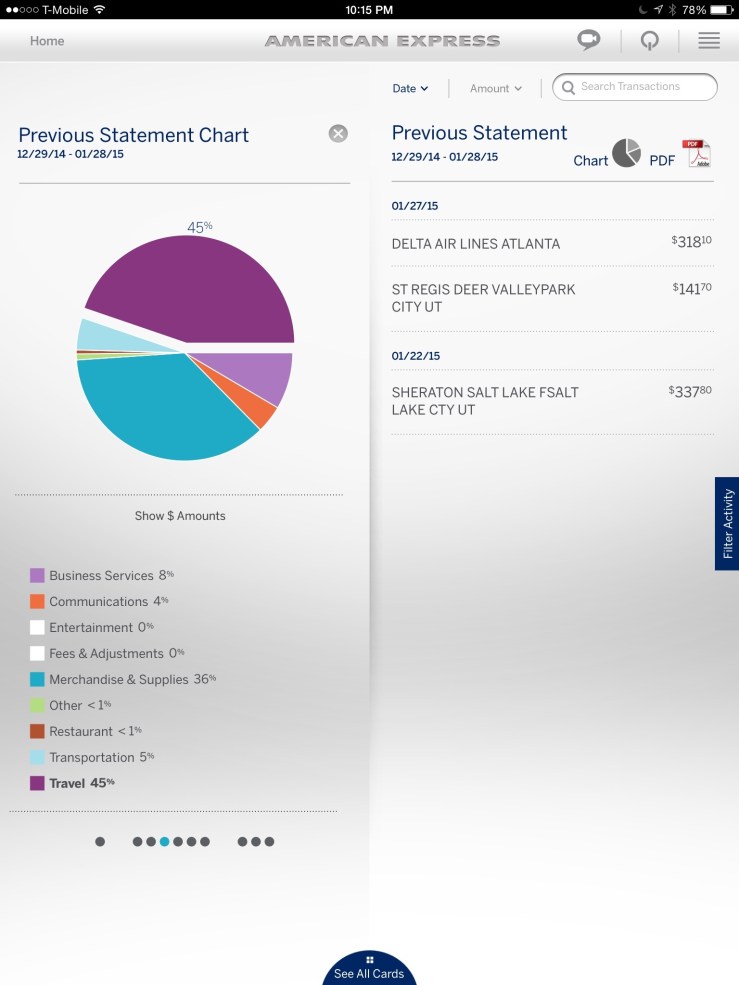
redesign | travel: How would you improve this St. Regis hotel bath collection?

The big issue here is that all three bottles look alike. There is shampoo, conditioner and body wash. But it’s not easy to tell which is which without picking up the small, likely wet bottles.

That’s bad enough for the typical person. But for people like me, who are blind as a bat, it is a serious issue. Without my glasses or contacts — the standard when I’m taking a shower — I couldn’t read the text until the bottle was within 5″ of my eyes.

Unfortunately, this is the status quo at hotels. They all have tiny bottles that are impossible to read. Some hotels have their amenities in clear plastic bottles, which makes it easier to distinguish the blue shampoo from the white conditioner. But you still have to figure out which is which.

My ideal solution has two parts:

  • Large letters on each bottle. S = Shampoo, B = Body wash, C= Conditioner.
  • Different shaped bottles. For example, circle for shampoo, square for conditioner, triangle for the body wash.

Changing the labels is relatively easy. Changing the shape of the bottles is more complicated.

Because chains use standardized toiletries, learning one would help you at multiple hotels. (On the flip side, it makes the roll out process longer.)

This isn’t just a usability issue; it could be an issue under the Americans with Disabilities Act.

This quiz was so easy that a lot of people got the correct answer:

https://twitter.com/tim_poor/status/560108962696425472

Which is why it’s odd that hoteliers don’t seem to see the problem.

But at least St. Regis hotels have a sense of humor. They responded to my question:

Why Google’s MVNO is unlikely to make a huge impact


The Information reported that Google will be launching an MVNO, reselling wireless service from the Sprint and T-Mobile networks. This has little chance of making a significant impact on the U.S. wireless market.

What is an MVNO?

To understand what Google is doing, it’s important to understand what an MVNO is. The acronym stands for Mobile Virtual Network Operator. These are companies that buy network service from companies like AT&T, T-Mobile, Sprint and Verizon at wholesale prices and then resell them to consumers at retail prices. Often, these prices are much lower for low-usage customers than the big brand names. The MVNO handles pricing, packaging, marketing, billing and customer service. (This is a simplification.)

Why do MVNOs exist? Continue reading “Why Google’s MVNO is unlikely to make a huge impact”

redesign | apple: What’s wrong with how Siri is responding to a request to send a message?

Connect button

The big issue here is that Siri says “I’ll send your message.” Was it sent? Or is it stuck somewhere? Will it be sent immediately or 10 minutes from now?

Continue reading “redesign | apple: What’s wrong with how Siri is responding to a request to send a message?”

redesign | google: What’s the most obvious thing wrong with this Google Maps experience?

Google is telling us “No route found”. This a fairly simple request, from my location to Target. But Google didn’t check to see if there was connectivity before presenting the error message. This shows a common problem in UX design.

Continue reading “redesign | google: What’s the most obvious thing wrong with this Google Maps experience?”

redesign | apple: How would you improve this iMessage experience?

Connect button

There are three keys to solving this puzzle:

  • The hashtag #lowbandwidth.
  • The E indicator in the status bar, showing that the phone is on and Edge network.
  • The stuck “Sending…” indicator.

My answer here is to fall back to SMS when the data network doesn’t work. Apple has created its own messaging system that runs over your phone’s data connection. In most cases, this is good. It allows Apple to deliver a richer set of features, free international messaging and can be faster.

But SMS is more robust because it uses a separate signaling channel. (This is why you should use SMS in emergency situations.)

One of my frustrations with a lot of mobile design is that it ignores low-bandwidth use cases. That’s important for areas where there is sparse coverage. It’s also important if you want your app to work reasonably well in international markets.

Some other answers from Twitter:

This really works best in normal- or high-bandwidth situations. Pre-fetching also uses data that a user on a metered data plan might not want to use.

https://twitter.com/vmarks/status/555381389353562112

I use Glympse for this, largely out of habit. But the latest version of iOS does include sending location.

Connect button

redesign | ux: How would you improve this Google Maps experience?

This quiz if focused on the items shown in the picture, specifically Budget and Avis. (Judging from the Twitter answers, that was unclear.)

Frequent travelers often rent cars. This involves picking up the car and eventually returning the car. Google could automatically track where you began your rental (in my case, Avis). When you want to return to the airport, instead of directing you to the airport terminal, it could automatically guide you back to the rental car return. One way to do this is to use GPS trace data. i.e. look at the paths of people who have rented from Avis and look at where they return the car.

Bonus points for showing me the last gas station on the route so that I don’t get stuck paying $9 a gallon to have the car rental company refill the tank. (Travel tip: You should almost never accept the prepaid fuel option.)

Some Twitter answers that reflect other issues with Google Maps.

https://twitter.com/Very_QC/status/555793461761564673