

Designing AVs for people

Elderly woman with cane standing on sidewalk near crosswalk as autonomous car approaches stop sign

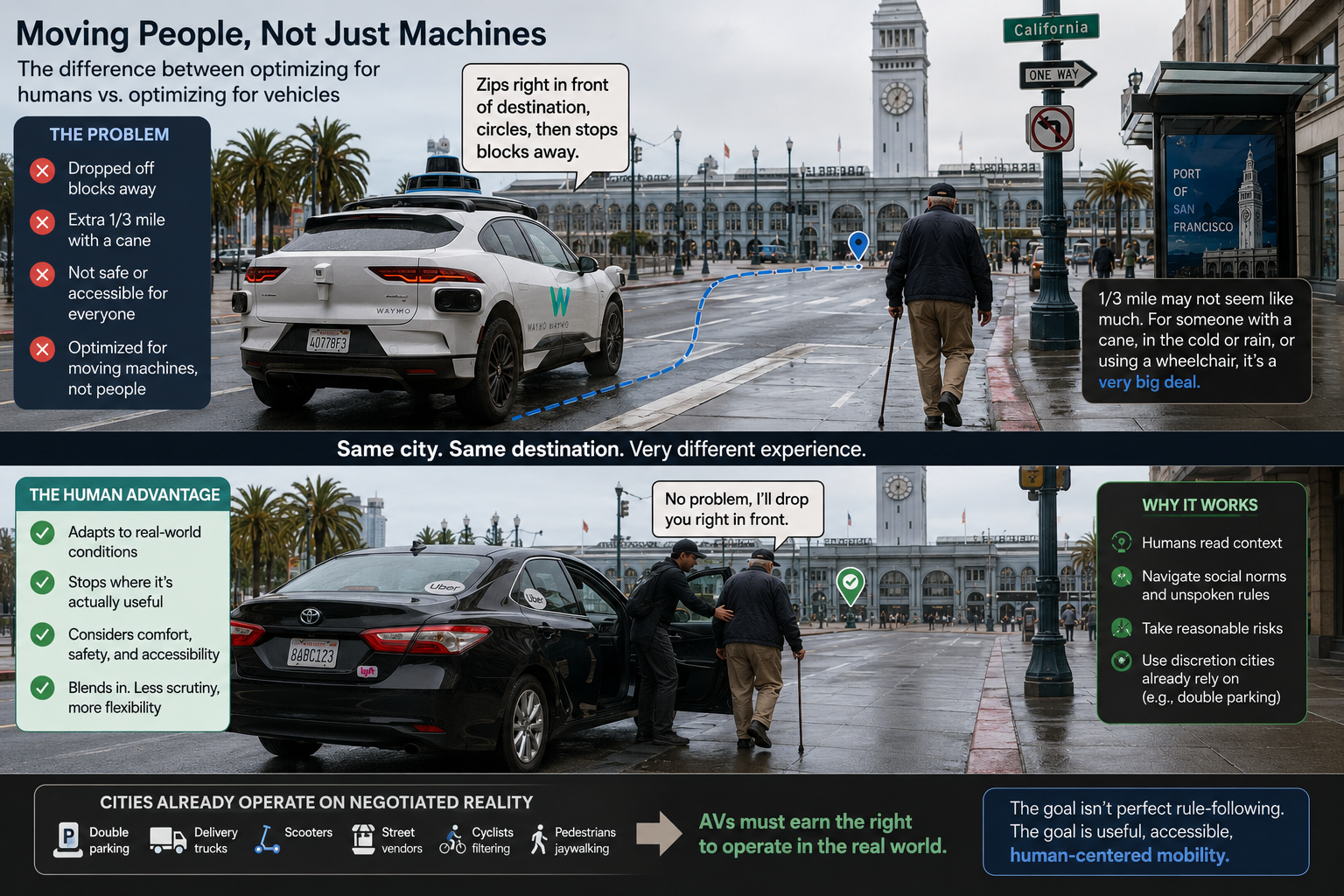
My dad had to walk an extra 1/3 mile the other day. With a cane.

Our Waymo zipped right in front of our destination, circled and then came to a stop a few blocks away.

As is often the case in technology, the designers didn’t have any empathy.

They optimized based on moving machines around, not moving people around. Those are fundamentally different optimization problems. Unlike products at Amazon fulfillment centers, people aren’t payloads. (Most of this post is focused on truly autonomous vehicles; I’ll touch on L2+ like the Mercedes Benz/Nvidia solution later.)

For an able-bodied person in good weather, walking 1/3 of a mile isn’t a big deal. For someone who needs a wheelchair or a cane, it is a very big deal. Others don’t want to step into snow and slush if it can be avoided.

Ride apps like Uber and Lyft have a big advantage: drivers can localize for the conditions based on what they see. A human driver isn’t going to drop you at the bottom of California St. with a 25% grade. (That’s not even the worst in SF; one street goes to 41%.)

In my dad’s case, we would have asked the human driver to stop right in front of the Ferry Building. He’d turn on his flashers, double park or inch his way into the right lane to make that happen.

Waymo has another problem: PR and regulators. Because it’s vehicles are a driving billboard, mistakes like double parking will be posted on social media. Regulators will see the most egregious ones and hear about them.

On the other hand, disability activists will protest that they are being dropped off in places where the service is not useful. That again will get to regulators by way of interest groups.
When I design software products, unnecessary friction means an extra click or a confusing interface. I optimize as many of those out as I can. But when I develop hardware, it’s a whole different problem and the shipping bar is much higher.

Driving is a shared environment. We’ve long had bicyclists, motorcycles, pedestrians and cars sharing the road, curbs and sidewalks. Recently, we’ve added Lyft/Lime scooters. We’re now adding delivery robots and AVs.

In order for this to work in an environment like San Francisco and New York, we have to tolerate things that are technically illegal. If we didn’t, SF and NY would be paralyzed. This is so well accepted that UPS and FedEx get special high-volume rates for their double parking tickets.

In this video, Nvidia CEO Jensen Huang comments as his AV Mercedes drives through San Francisco. Double-parked car? Just go around through on-coming traffic. Technically, illegal, but realistically necessary.

Mercedes and Nvidia have the advantage that their vehicles aren’t driving billboards. (There are a view test vehicles that have Mercedes and Nvidia test vehicle markings.) Like Uber and Lyft, they have the benefit of adaptability by humans for the places where it is needed. Also like Uber and Lyft, they are driving in incognito mode.

Whether it is L2+. L3 or higher, we’re going to need to re-negotiate our social contracts. AVs will have to adapt, as will humans.

Three things I got right as a PM leader

Previous post: Three things I got wrong as a PM leader.

Understanding customer psychology is key

The best products come from the intersection of technology and psychology. Part of the fun of creating new products is trying to figure out things other people haven’t. Imagine someone dumped a pile of small, multi-colored plastic shapes that interlock in front of you in 1948. Dump them in front of someone and they’ll think it is junk.

Put a picture of a houses or airplane on the box and they’ll be able to fill in the gaps. This is what I can do with those Legos. You’ve provided people a framework for understanding and sparking their creativity.

Understanding psychology includes using all of the senses. Incorporate sight, sound, touch, smell and taste. (OK, smell and taste aren’t necessarily applicable to online products.)

I was at a ski resort and their lift ticket scanners would beep when the ticket was scanned. But the beep was just a confirmation that it was scanned, not an indicator of whether it was valid. The liftie had to look at the display to see the ticket status. It could mean moving gloves out in the cold. If I were designing it, the scanner would beep differently based on whether the ticket was valid or not. There would also be big green and red lights on top the scanner.

Haptics are often overlooked, but they can be very useful. When you’re using walking directions, Apple Watch will tap you on the wrist to indicate that you need to make a turn. What they could do better: have a different tap pattern based on whether you need to make a left turn or right. You wouldn’t have to look down at the watch to see the arrow.

Price is not everything

Yes, price matters. But understanding and being able to contextualize price is important. 

We had a feature-rich product that you could use in a lot of different ways — making phone calls, checking email, storing files and sending faxes (!). It was a great set of features, but because it was a new product, people had no understanding of how much it should cost. In fact, we were underpricing it. I was able to create bundles of features that were more widely understood and comparable to how competitors priced things. We were able to double prices and double adoption.

Think carefully about whether you want to charge at all. There is a much bigger psychological difference between $0.00 and $0.01 than between $0.01 and $1.00.

Simplicity of payment also matters. In the Bay Area, there are more than two dozen transit agencies. Each has its own pricing and fare structure. Passes are different. Not only did you have to figure out how much it cost, your had to figure out how to pay. The payment part was simplified by having an NFC card that worked across the systems. 

Some systems have gotten even simpler. In NYC and London, you can use your contactless credit card. No more having to find and buy a separate card.

If you’re shipping physical products, it’s a giant mistake to not incorporate Apple Pay. Apple created a great system to minimize friction in online commerce. Use it. This is especially true if you have low frequency customers.

Whoever sets the defaults controls the world

In general people want to do the least amount of effort, especially things that they aren’t super interested in. They will do whatever is easiest. 

The new tablet-based point-of-sale systems make it easy to tip 15%, 18%, 20% etc. (depending on the system). You can tip less or more, but that usually requires going to a submenu and entering an amount. Not only is picking the pre-filled amounts easier, it tells users that they should tip one of those amounts. (Hey cheapskate!)

Think about walking through a supermarket. The big brands make it convenient to buy their products. They pay slotting fees to grocers to ensure that their products are at eye level or on the end caps. The better values, either in terms of quality or price, aren’t at eye level.

By setting the right defaults, you can push the metrics you want toward your preferred direction.

Three things I got wrong as a PM leader

Listening to customers

Listening to your customers can lead you down the wrong path, whether you are talking about consumer or enterprise customers. People don’t necessarily know what they want. People don’t know what’s possible. Some people want the kitchen sink.

I find focus groups to be essentially useless when testing innovation. If you want to test new fragrances for Tide, go ahead. But if you want to test a brand new concept, focus groups won’t get it. 

Listening to your early adopters is especially dangerous. They might seem like the “best” customers because they came to you first. Unfortunately, that’s a small base and likely unrepresentative of your target market if you’re looking for mass scale.

Better than listening to your customers is understanding your customers. You can watch what potential customers do. Be in their environment. Building a product for restaurant kitchens? Go work the line for a day. Think of it as a mini Undercover Boss. You can often learn more in observing for 15 minutes than two hours of conversation.

I sat looking over the shoulders of people using one of my products. I watched as they cut-and-pasted data from one window to another and then made minor edits. It was tedious. I went back and redesigned it so that my system (the new one) pre-populated the data from the older system.

If you’re testing a new product with real users, watch them use it and see where they get stuck. Try not to help them – you won’t be there to help them when they’re using your product in real life.

Adding too many features

As a nerd, I’ve always wanted more features. I’m the person who went through all of the settings screens to customize every new product or service to exactly my taste. 

What I discovered early on is that most people don’t want more features. In an early product, we had search results pages for news stories. I added in controls to allow you to pick how many stories showed up on a page and how large an excerpt from each story you wanted to see. 

Terrible idea. It complicated the page for users. They had the additional cognitive load of looking at those controls versus seeing what they came for. It also made it harder and slower to render the page. We were better off just stripping all of that code out and delivering the pages faster. 

Product managers might not think of “speed” as a feature, but it’s one of the most critical ones. Take too long to render and people will go elsewhere.

In an early test at Google, customers said they wanted 30 results per page. When it was rolled out, the page with 10 results was the winner. It rendered 0.5 seconds faster.

My own needs have changed over time. I don’t want more features. I don’t want more settings pages. I want things to work out of the box.

Believing you can’t fight City Hall

This one will undoubtedly be controversial. Sometimes the biggest innovation comes from pushing the boundaries. If you had paid strict attention to copyright laws, you might avoid building Google. The search engine literally copied almost everything online, word-for-word. 

A friend had an idea for an on-demand transportation company. After thinking about it, he decided that it would violate local taxi ordinances, employment laws and be a liability nightmare and decided not to pursue it. Uber said “screw it” and went for it. It’s now a $140 billion business.

This is an area where startups have a huge advantage over large companies. BigCo lawyers will say “no” to anything that presents a sizable risk to their core business. It takes 10 people to say “yes” and 1 person to say “no.” See my post “Could YouTube have come from a large company?” (The post is from 2006, so a lot of the questions I asked then have been answered.)

Sometimes, as with YouTube, getting sued can be great for the business.

Startups also need to be wary of people who have spent all of their time in big companies. It may be tempting to hire someone who has 25 years of payments expertise for your payments company. You just need to make sure they don’t have all of the rules and “we can’t do that” baked in.

As my friend and noted angel investor Gokul Rajaram says, it’s important to push the boundaries, just don’t to things that might have you end up in jail. If you do go over the line, you might be joining Elizabeth Holmes and Sam Bankman-Fried.

Part 2: Three things I got right…