
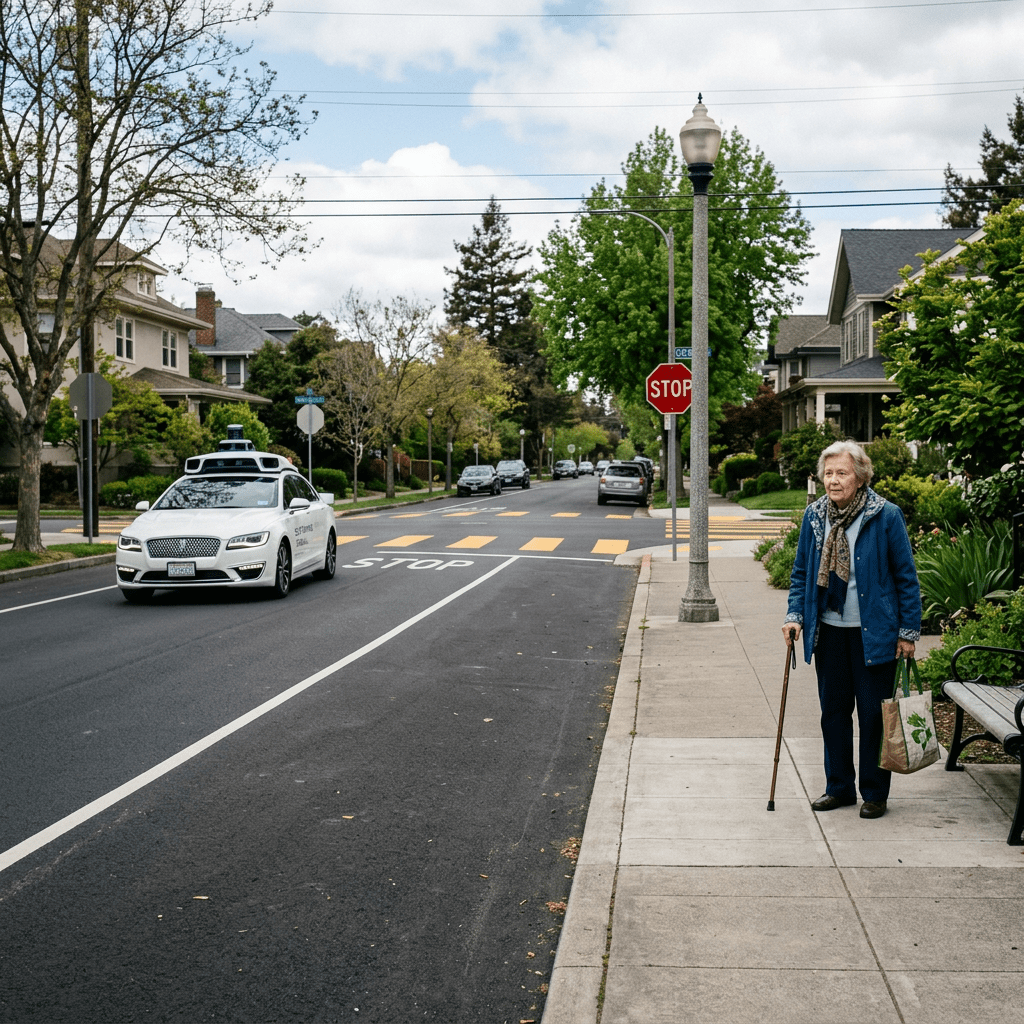
My dad had to walk an extra 1/3 mile the other day. With a cane.
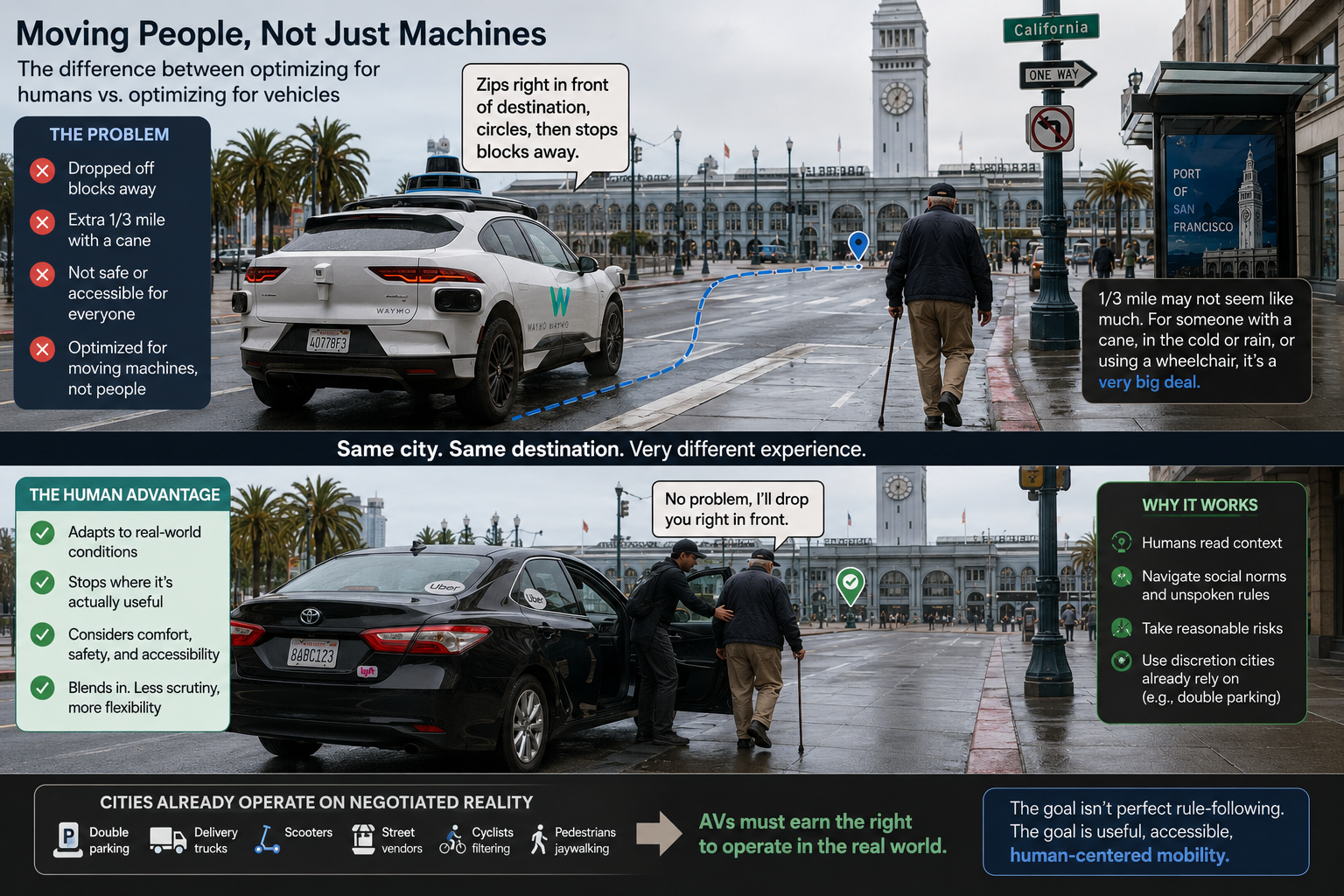
Our Waymo zipped right in front of our destination, circled and then came to a stop a few blocks away.
As is often the case in technology, the designers didn’t have any empathy.
They optimized based on moving machines around, not moving people around. Those are fundamentally different optimization problems. Unlike products at Amazon fulfillment centers, people aren’t payloads. (Most of this post is focused on truly autonomous vehicles; I’ll touch on L2+ like the Mercedes Benz/Nvidia solution later.)
For an able-bodied person in good weather, walking 1/3 of a mile isn’t a big deal. For someone who needs a wheelchair or a cane, it is a very big deal. Others don’t want to step into snow and slush if it can be avoided.
Ride apps like Uber and Lyft have a big advantage: drivers can localize for the conditions based on what they see. A human driver isn’t going to drop you at the bottom of California St. with a 25% grade. (That’s not even the worst in SF; one street goes to 41%.)
In my dad’s case, we would have asked the human driver to stop right in front of the Ferry Building. He’d turn on his flashers, double park or inch his way into the right lane to make that happen.
Waymo has another problem: PR and regulators. Because it’s vehicles are a driving billboard, mistakes like double parking will be posted on social media. Regulators will see the most egregious ones and hear about them.
On the other hand, disability activists will protest that they are being dropped off in places where the service is not useful. That again will get to regulators by way of interest groups.
When I design software products, unnecessary friction means an extra click or a confusing interface. I optimize as many of those out as I can. But when I develop hardware, it’s a whole different problem and the shipping bar is much higher.
Driving is a shared environment. We’ve long had bicyclists, motorcycles, pedestrians and cars sharing the road, curbs and sidewalks. Recently, we’ve added Lyft/Lime scooters. We’re now adding delivery robots and AVs.
In order for this to work in an environment like San Francisco and New York, we have to tolerate things that are technically illegal. If we didn’t, SF and NY would be paralyzed. This is so well accepted that UPS and FedEx get special high-volume rates for their double parking tickets.
In this video, Nvidia CEO Jensen Huang comments as his AV Mercedes drives through San Francisco. Double-parked car? Just go around through on-coming traffic. Technically, illegal, but realistically necessary.
Mercedes and Nvidia have the advantage that their vehicles aren’t driving billboards. (There are a view test vehicles that have Mercedes and Nvidia test vehicle markings.) Like Uber and Lyft, they have the benefit of adaptability by humans for the places where it is needed. Also like Uber and Lyft, they are driving in incognito mode.
Whether it is L2+. L3 or higher, we’re going to need to re-negotiate our social contracts. AVs will have to adapt, as will humans.


