redesign | transport: Uber should make safety a selling point

It seems not a day goes by recently that there isn’t bad news about Uber. There was was the driver in Delhi, the Sydney fiasco and most recently assaults by a driver in Boston. Some of the bad news is of Uber’s making; others are inherent in running a rapidly growing business at global scale with tens of thousands of independent actors.

All of this has added up to segment after segment on CNN bruising the company’s once stellar image. The company’s ineptness at PR exceeds even the depths of Groupon’s idiocy in its heyday.

Uber has failed to understand that as the company has grown, so have the expectations of consumers, regulators and the media. A 20-something male in San Francisco will be much more forgiving than a 45-year old mom with toddler in tow in Minneapolis. Regulators are more likely to let a startup slide than a company that is worth $40 billion.

There is also an irrationality to the marketplace that Uber can’t avoid (nor should it bring it up): even though Uber might be statistically safer, it suffers from the negative externality of the collection of bad experiences by independent operators. Most cab companies don’t operate at even a national level, much less a global one. People don’t associate taxi drivers with a specific brand; but they associate Uber drivers with Uber.

Given the structure of Uber model, Uber is undoubtedly safer than traditional taxis. But “we only have sexual assaults once a week” is not a message that you can sell.

There are ways to do much better. And Uber has taken a bizarre approach. Rather than be proactive and use its war chest to build a better, safer product, Uber prefers to wait until something bad happens and then reacts to it slowly. (After first saying, “not our fault! independent drivers!”)

Being proactive would allow Uber to claim the moral high ground. And because it has more resources than Lyft, put further strain on Lyft to catch up.

Uber’s next step should be to create the gold standard of safety and share those plans. It’s not just great for PR — it’s great for passengers, the business and for the world.

I’ve long thought that Uber would have a sizable market with a product like Uber for Parents — playing soccer mom and car pool driver. But that sure as hell can’t happen until the current perceptions of Uber safety continue.

redesignAnswer: Paper statements are more convenient

From Skitch (6)

I’m not a Luddite (clearly). I’m an environmentalist.

But the process for getting online statements is convoluted. Every bank has their own log in system. Everyone has their own archiving rules. Sometimes the format online doesn’t include the same information that the paper statement does.

It’s not hard to miss a statement alert in your email along with the hundreds or thousands of emails you get a month. This could easily lead to a pile of late fees and interest charges. Some issuers do a good job of identifying auto pay in their e-statements; some do a terrible job.

It’s next to impossible to search across the statements from issuers. Ironically, I scan all the paper that is sent to me and then shred them. (I scan them into Evernote to make them easily searchable.)

The paper also serves as a reminder that I need to pay the bill.

What would get me to move to digital statements?

  • If I could get them in secure email, just as easily as I get them in the physical mailbox. 
  • Better design of online statements.
  • An easier way to access them.

redesignAnswer: Paper statements are more convenient

From Skitch (6)

I’m not a Luddite (clearly). I’m an environmentalist.

But the process for getting online statements is convoluted. Every bank has their own log in system. Everyone has their own archiving rules. Sometimes the format online doesn’t include the same information that the paper statement does.

It’s not hard to miss a statement alert in your email along with the hundreds or thousands of emails you get a month. This could easily lead to a pile of late fees and interest charges. Some issuers do a good job of identifying auto pay in their e-statements; some do a terrible job.

It’s next to impossible to search across the statements from issuers. Ironically, I scan all the paper that is sent to me and then shred them. (I scan them into Evernote to make them easily searchable.)

The paper also serves as a reminder that I need to pay the bill.

What would get me to move to digital statements?

  • If I could get them in secure email, just as easily as I get them in the physical mailbox. 
  • Better design of online statements.
  • An easier way to access them.

redesignAnswer: The trapezoidal package contained an iMac


From Skitch (3)


This package contained an iMac.

There are two things wrong with this packaging:

  • The trapezoidal shape doesn’t stack or fit well in delivery trucks.
  • Very few packages come in a trapezoidal shape. Thieves are more likely to notice this and assume that it contains a high-value item. (And they’d be right a large portion of the time.)

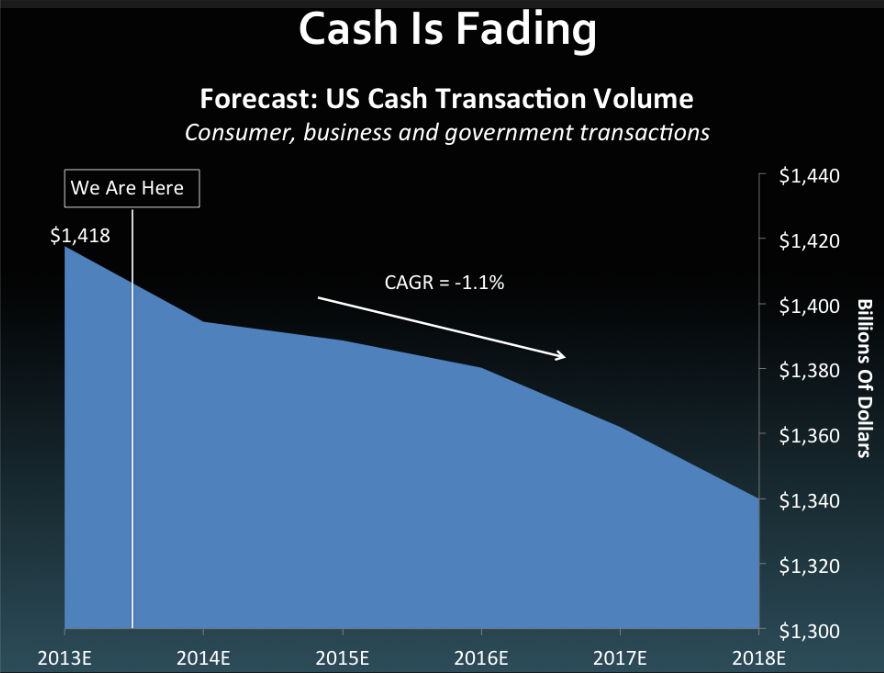
redesignAnswer: If this chart started with 0 on the Y axis, the line would be flat


screenshot2


At first glance, this graph implies that U.S. cash transaction volume is plummeting. But look at the right side. The axis starts at $1,300 billion. If this graph had 0 on the Y axis, the line would essentially be flat. As posted, the graph is highly misleading.

Not using zero as the basis of the Y axis can be useful in certain cases, like analyzing short-term price movements in a stock. But this is a terrible use of it. Or maybe it’s a great use — because the writer wants to make a point unsupported by the data. But it’s still wrong.

Bonus error pointed out by a reader: The “We Are Here” line shows us between 2013 and 2014. We’re between 2014 and 2015.

redesignAnswer: Crate and Barrel should stagger delivery of catalogs

I received the catalogs from Crate and Barrel and CB2 on the same day. 

It’s better to spread that delivery out over multiple days because it increases the likelihood that I’d look at one of them. On the same day, it’s possible that I’m on vacation and come back to a pile of mail, my (hypothetical) spouse picks up the mail and tosses it out, etc. Spreading the delivery out doubles the chance that I’ll look at it.

To address some other comments from readers:

  • Crate and Barrel and CB2 can’t hide that they’re the same brand. Well, they don’t try to hide it anyway. All of the multibrand retailers don’t try to hide it. Crate and Barrel/CB2/LandofNod, Williams-Sonoma/Pottery Barn/West Elm, Banana Republic/Gap/Old Navy/Piperlime/Athleta. There is often cross promotion. And some customers shop multiple brands. e.g. I shop Crate and Barrel and CB2, Banana Republic and Gap, Williams Sonoma and Pottery Barn.
  • It’s a waste of paper. Sure, many people would consider it a waste of paper. But these catalogs are expensive to produce and distribute. If they didn’t work, they wouldn’t be used. I browse these catalogs while on the toilet. It’s a lot easier to skim through a catalog with rich visuals than the equivalent online experience.
  • My recent customer-service issues with Crate and Barrel. Some recalled that I had a bad in-store experience at Crate and Barrel where the clerk insisted on a physical address for a store pickup. After some back-and-forth, I gave my address as 1600 Pennsylvania Avenue, Washington, DC. Although the White House might receive my catalog as a result, I got these catalogs because I have a Crate & Barrel credit card. (Possible future quiz: why do I have a Crate & Barrel credit card?)


redesignAnswer: Uber could improve passenger and pedestrian safety by using tech to monitor drivers

I was waiting for an Uber and the driver zoomed past me at 35 miles an hour in downtown SF. (Why you wouldn’t drive slower when you’re approaching a passenger is beyond me.) When I flagged him down on the one way street, he backed up in heavy traffic to get to me.

That is the kind of driver that shouldn’t be on Uber’s platform. When I reported what happened, Uber took note and said they were going to reach out to the driver.

But the current process requires active input from passengers. Unless a drive is egregiously bad, most people wouldn’t bother.

Technology provides an easy answer to the problem: passively tracking driver behavior. If someone has a lot of quick stops, swerves a lot, brakes hard or speeds down city streets, that person shouldn’t be on the Uber system.

There’s also another huge advantage: you can track driver behavior when they don’t have a passenger but are logged on the system. The current Uber model provides a strong incentive for drivers to be reckless when they don’t have a passenger. 

For the level of detail that Uber needs to bump bad drivers off the system, the sensors on modern phones are great. 

There are technologies that provide even better data. A start up called Automatic sells a device that consumers can plug into the OBD-II port on 1996 or later cars. The app warns you when you are speeding and braking hard. it also provides logs of your driving and average miles per gallon.

My auto insurance is from Metromile, which uses data from the OBD-II port to charge me by the mile instead of typical pricing models. (I estimate that I’ll save 30% off my former GEICO rates.) Incidentally, Metromile won’t provide coverage while you’re providing taxi services with Uber.

One survey respondent suggested deactivating the Uber app while the vehicle is in motion, much like some embedded navigation systems. Unfortunately, the app is so dependent on people interacting while driving that that won’t happen.

Many taxi drivers are reckless, too. But we can’t do much about that.