
20 years of Google Maps

Today marks 20 years since Google changed the online mapping paradigm. Instead of Mapquest’s bitmapped maps, Google allowed superior control within the browser dynamically loading tiles.

I’ve been working in mapping and local products for longer than Google Maps has existed. Here are my observations of the industry, with a focus on Google.

  • The seed of Google Maps was an acquisition of an Australian company called Where 2.
  • Google Earth came from another acquisition, Keyhole.
  • When John Hanke, founder of Keyhole, asked Larry and Sergey to buy better imagery of the US, they asked how much it would cost to buy the whole world. They bought the whole world.
  • Before the acquisition, Keyhole was running out of money. They asked who on the team was willing to trade salary for more equity. Clearly, the latter group made out.
  • When Maps launched, the head of Mapquest at the time would often send all-hands emails to AOL employees about how no one would ever use Google Maps and how poor its traction was. (Somehow Mapquest is still around, but Yahoo! Maps is gone.) A lot of Mapquest’s dev team was based in Lancaster, PA. Lancaster is not the home of prime engineering talent and the product reflected it.
  • I was at a Google shareholder meeting where someone asked why Google was wasting so much money on Maps. The answer was essentially, “it’s our company, next question.” Of course it is now a key differentiator.
  • Amazon’s A9 division launched a version of Street View earlier than Google. Ironically, I was interviewing at Google at the time and one of my interviewers said “that will never scale.” (Even earlier than that, I launched street views for real estate in Minneapolis.)
  • The day Google announced turn-by-turn directions, Garmin shares plummeted. Google might have done Garmin a favor: Garmin instead focused on the more lucrative aviation, marine and sports enthusiast markets.
  • The launch of offline maps put another nail in the coffin of portable navigation devices that used to dot the windshields of cars across the country.
  • Google launched an extensive marketing campaign in Portland for Maps. I guess it wasn’t that successful because it wasn’t deployed elsewhere. I did get a lot of swag and some free drinks out of it.
  • Apple Maps was a disaster when it launched in 2012. I did an interview with NPR’s Science Friday about it. Now it is by far my preferred mapping product.
  • As you would expect from Apple, the visualizations are gorgeous. The integration with Apple Watch and AirPods is brilliant for when I’m walking. I primarily use it when I’m walking, taking transit or renting a car (CarPlay). Unfortunately, the Tesla doesn’t allow CarPlay, so I’m stuck with an ugly version of Google Maps that looks like what Maps did in 2005 and worse than the later generations of PNDs.

Local is one of the most difficult problems out there. Businesses open and close all the time. (POI data is especially hard!) New roads get added. Construction temporarily re-routes roads. Roads are temporarily closed for events like marathons. Traffic data can be inaccurate.

Maps are ever evolving and there’s a long road ahead. Check out some of my wishlist and writings about maps. If you really want to go back through the history of maps on my older blog.

Disclosure: I’m an investor in all of the public companies named. Mapquest is part of a Yahoo!, which is primarily owned by Apollo after another failed content play by Verizon.

Three things I got right as a PM leader

Previous post: Three things I got wrong as a PM leader.

Understanding customer psychology is key

The best products come from the intersection of technology and psychology. Part of the fun of creating new products is trying to figure out things other people haven’t. Imagine someone dumped a pile of small, multi-colored plastic shapes that interlock in front of you in 1948. Dump them in front of someone and they’ll think it is junk.

Put a picture of a houses or airplane on the box and they’ll be able to fill in the gaps. This is what I can do with those Legos. You’ve provided people a framework for understanding and sparking their creativity.

Understanding psychology includes using all of the senses. Incorporate sight, sound, touch, smell and taste. (OK, smell and taste aren’t necessarily applicable to online products.)

I was at a ski resort and their lift ticket scanners would beep when the ticket was scanned. But the beep was just a confirmation that it was scanned, not an indicator of whether it was valid. The liftie had to look at the display to see the ticket status. It could mean moving gloves out in the cold. If I were designing it, the scanner would beep differently based on whether the ticket was valid or not. There would also be big green and red lights on top the scanner.

Haptics are often overlooked, but they can be very useful. When you’re using walking directions, Apple Watch will tap you on the wrist to indicate that you need to make a turn. What they could do better: have a different tap pattern based on whether you need to make a left turn or right. You wouldn’t have to look down at the watch to see the arrow.

Price is not everything

Yes, price matters. But understanding and being able to contextualize price is important. 

We had a feature-rich product that you could use in a lot of different ways — making phone calls, checking email, storing files and sending faxes (!). It was a great set of features, but because it was a new product, people had no understanding of how much it should cost. In fact, we were underpricing it. I was able to create bundles of features that were more widely understood and comparable to how competitors priced things. We were able to double prices and double adoption.

Think carefully about whether you want to charge at all. There is a much bigger psychological difference between $0.00 and $0.01 than between $0.01 and $1.00.

Simplicity of payment also matters. In the Bay Area, there are more than two dozen transit agencies. Each has its own pricing and fare structure. Passes are different. Not only did you have to figure out how much it cost, your had to figure out how to pay. The payment part was simplified by having an NFC card that worked across the systems. 

Some systems have gotten even simpler. In NYC and London, you can use your contactless credit card. No more having to find and buy a separate card.

If you’re shipping physical products, it’s a giant mistake to not incorporate Apple Pay. Apple created a great system to minimize friction in online commerce. Use it. This is especially true if you have low frequency customers.

Whoever sets the defaults controls the world

In general people want to do the least amount of effort, especially things that they aren’t super interested in. They will do whatever is easiest. 

The new tablet-based point-of-sale systems make it easy to tip 15%, 18%, 20% etc. (depending on the system). You can tip less or more, but that usually requires going to a submenu and entering an amount. Not only is picking the pre-filled amounts easier, it tells users that they should tip one of those amounts. (Hey cheapskate!)

Think about walking through a supermarket. The big brands make it convenient to buy their products. They pay slotting fees to grocers to ensure that their products are at eye level or on the end caps. The better values, either in terms of quality or price, aren’t at eye level.

By setting the right defaults, you can push the metrics you want toward your preferred direction.

Three things I got wrong as a PM leader

Listening to customers

Listening to your customers can lead you down the wrong path, whether you are talking about consumer or enterprise customers. People don’t necessarily know what they want. People don’t know what’s possible. Some people want the kitchen sink.

I find focus groups to be essentially useless when testing innovation. If you want to test new fragrances for Tide, go ahead. But if you want to test a brand new concept, focus groups won’t get it. 

Listening to your early adopters is especially dangerous. They might seem like the “best” customers because they came to you first. Unfortunately, that’s a small base and likely unrepresentative of your target market if you’re looking for mass scale.

Better than listening to your customers is understanding your customers. You can watch what potential customers do. Be in their environment. Building a product for restaurant kitchens? Go work the line for a day. Think of it as a mini Undercover Boss. You can often learn more in observing for 15 minutes than two hours of conversation.

I sat looking over the shoulders of people using one of my products. I watched as they cut-and-pasted data from one window to another and then made minor edits. It was tedious. I went back and redesigned it so that my system (the new one) pre-populated the data from the older system.

If you’re testing a new product with real users, watch them use it and see where they get stuck. Try not to help them – you won’t be there to help them when they’re using your product in real life.

Adding too many features

As a nerd, I’ve always wanted more features. I’m the person who went through all of the settings screens to customize every new product or service to exactly my taste. 

What I discovered early on is that most people don’t want more features. In an early product, we had search results pages for news stories. I added in controls to allow you to pick how many stories showed up on a page and how large an excerpt from each story you wanted to see. 

Terrible idea. It complicated the page for users. They had the additional cognitive load of looking at those controls versus seeing what they came for. It also made it harder and slower to render the page. We were better off just stripping all of that code out and delivering the pages faster. 

Product managers might not think of “speed” as a feature, but it’s one of the most critical ones. Take too long to render and people will go elsewhere.

In an early test at Google, customers said they wanted 30 results per page. When it was rolled out, the page with 10 results was the winner. It rendered 0.5 seconds faster.

My own needs have changed over time. I don’t want more features. I don’t want more settings pages. I want things to work out of the box.

Believing you can’t fight City Hall

This one will undoubtedly be controversial. Sometimes the biggest innovation comes from pushing the boundaries. If you had paid strict attention to copyright laws, you might avoid building Google. The search engine literally copied almost everything online, word-for-word. 

A friend had an idea for an on-demand transportation company. After thinking about it, he decided that it would violate local taxi ordinances, employment laws and be a liability nightmare and decided not to pursue it. Uber said “screw it” and went for it. It’s now a $140 billion business.

This is an area where startups have a huge advantage over large companies. BigCo lawyers will say “no” to anything that presents a sizable risk to their core business. It takes 10 people to say “yes” and 1 person to say “no.” See my post “Could YouTube have come from a large company?” (The post is from 2006, so a lot of the questions I asked then have been answered.)

Sometimes, as with YouTube, getting sued can be great for the business.

Startups also need to be wary of people who have spent all of their time in big companies. It may be tempting to hire someone who has 25 years of payments expertise for your payments company. You just need to make sure they don’t have all of the rules and “we can’t do that” baked in.

As my friend and noted angel investor Gokul Rajaram says, it’s important to push the boundaries, just don’t to things that might have you end up in jail. If you do go over the line, you might be joining Elizabeth Holmes and Sam Bankman-Fried.

Part 2: Three things I got right…

Be careful of virtual payments at hotels

Digital payments have no doubt had a positive effect. We can transact online and that gets easier and easier. Fraud is continually reduced. Companies like Stripe, Square and Shopify make it easy for small businesses to get online quickly. I was able to set up a shop on Shopify in about 30 minutes.

But with that convenience comes a challenge when you’re traveling.

Online travel agencies like Expedia, Priceline and others often take money upfront from customers by credit card. At check in, the customer is asked to provide a card for “incidentals.”

The problem is that sometimes the card gets charged for the room rate, something the customer has already paid.

The way hotels get paid by OTAs is through virtual cards. With a reservation, they also receive a virtual card to charge the wholesale rate. Hotel systems are designed to split bills. When it works correctly, the room rate is billed to the OTA’s virtual card and incidentals are billed to the card the customer provided at check in.

When it doesn’t work, the customer’s card is also charged the wholesale rate. I had this happen to me at Emeline in Charleston, S.C. I was charged an extra $386.10. It took many phone calls among hotels and with American Express to resolve this.

Unfortunately, there is little that travelers can do to avoid this. The best you can do is check your credit card bills for an extra charge and then complain. Most people at the hotel won’t know what’s you’re talking about. It is an easier conversation if you ask the hotel “did you charge me instead of the virtual card?”

Redesigning the self-driving future

I am driving with Tesla’s Full Self-Driving (Supervised). As I approach, the steering wheel seems to be freaking out, moving back-and-forth quickly. The car’s apparent freak out causes me to freak out.

After a few turns like this, I realize what’s happening: the car is making micro adjustments during the turn.

A human doesn’t make those micro adjustments. We wouldn’t be capable of fine tuning that rapidly. We don’t have to be perfect, we just need to get where we are going. If we’re a little bit off the center arc of our turn, that’s fine.

It would have been a more comfortable experience if the car just smoothed out those micro adjustments. They would still be done, but anything that was tiny wouldn’t provide feedback via the steering wheel.

This is similar to when anti-lock brakes came out on cars. The long-time advice in driver’s ed class was that you should slowly pulse the brakes to avoid going into a skid. With ABS, it is different. You should stomp on the brakes. The ABS then pulses the brakes faster and with more control than a user could. As with the Tesla steering wheel, the brake pedal provided vibrating feedback – not a comforting user experience.

I was in a Waymo the other day. Because the ride was so comfortable, I sat back and enjoyed the conversation with my friend. That was interrupted by a “click-click, click-click, click-click.” The car was indicating that it was about to make a turn. The signal action is very useful information for the cars and pedestrians around it. The clicking is useful for human drivers. It isn’t useful or necessary for passengers in a self-driving car. (In the transition period, the clicking might make passengers more comfortable. Perhaps it could be a preference setting.)

We are going through a major transition in transportation. As we design the new experiences, we need to be cognizant of:

  • What makes drivers more comfortable in a semi-autonomous environment? (L2/L3)
  • What makes passengers comfortable in an autonomous environment? (L4/L5)
  • What is vestigial that we can remove to create a better experience for both? (L3-L5)
  • How does the vehicle interact with the overall environment? (L3-L5)

We need to be looking at what we need to do during the transition as well as in the ideal future state.

You could have electrochroamatic glass that provides privacy to occupants. If the car is self-driving, you don’t really need to look out, do you?

One of my really future state ideas is auto-off headlights in autonomous environments. It’s the opposite of auto high-beams. When there is no one or no moving objects nearby, turn off the headlights and noisemakers to reduce light and sound pollution.

Of course all of this involves navigating a complex regulatory landscape that can vary by city, state and country. For the U.S., I’d like to see federal preemption. That might take a while. In California, cities like San Francisco, don’t even want state preemption.

Less please… decluttering online maps

Online maps have revolutionized how we travel. No more unfolding (and worse, refolding) paper maps or flipping through dated Thomas Guides. No driving around in circles because you made a wrong turn. Less getting stuck in traffic.

But as the technology, point-of-interest data and interfaces have improved, we’ve cluttered the user interface. Instead of focusing on what users care about, we’ve added lot of junk.

Consider the map above. How many people are going to randomly decide that they want to go to Floor & Decor, Enterprise Rent-A-Car, Valero (um, I’m driving an EV!), Quality Appliance Repair or Maple Auto Body? I’ve already told the computer my goal: getting to 2860 Spring St.

Maps should show:

  • What the user has searched for.
  • Where the user is.
  • Prominent navigational aids, e.g. near this screenshot you would have passed the airport.
  • Obstacles, e.g. traffic accidents.
  • Traffic lights and stop signs along the user’s route. (Inexplicably, Google Maps still doesn’t do this in the U.S.; Apple does.)

If the business model calls for it, ads can be shown.

Otherwise, get out of the user’s way!

Pin the map… on the map

Mapping has gotten so much better since I started working on maps in 2004. The quality of venue data has improved. Road data has improved. We have real-time traffic. The overall detail provided has improved – Apple even shows trees.

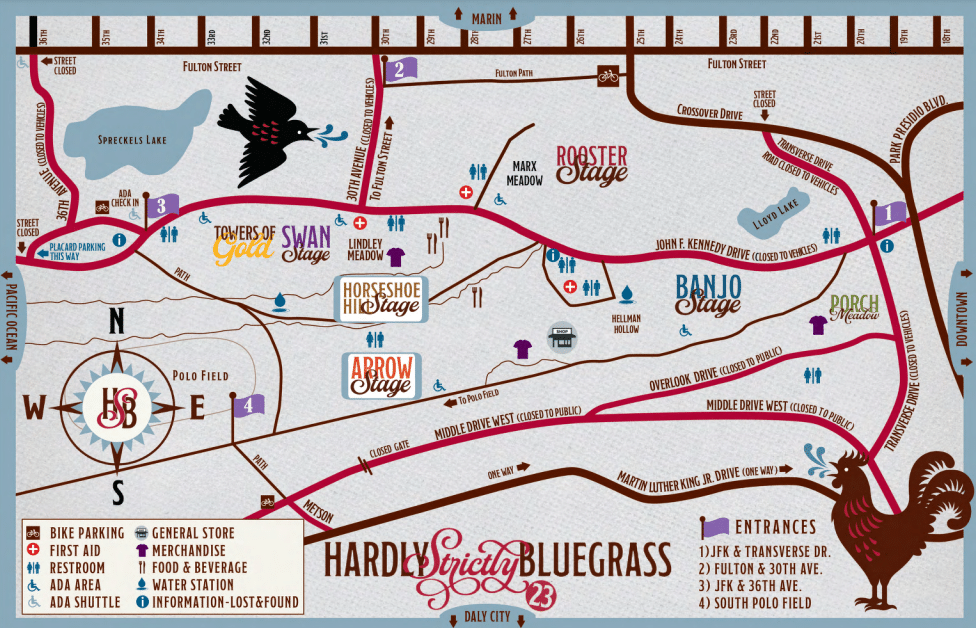
One important thing that hasn’t improved: temporary events. I went to the Hardly Strictly Bluegrass festival over the weekend. The organizers put together the terrible map above.

When I search for “hardly strictly bluegrass” on Google Maps, I get this:

(The pin doesn’t match my search term because apparently Google is pulling the text from a description of Hellman Hollow.)

I’ve got two maps: one that I can use for walking and directions and one that gives me a sense of what’s going on at the festival.

What I need is to marry the two. I want to route (using transit, walking, etc.) via the mapping tools I use normally but still know the details of my temporary event.

It starts from the very beginning: I had a very hard time finding the entrance gates because the event map was zoomed in too far to show the entrances to the park.

Given the source map from the venue, you could marry the roads with the roads in the digital map.

This approach would be useful for concerts, music festivals, marathons and other events. Bonus points for identifying road closures to keep traffic from getting snarled.

Pick a card, any card

Something many sites get wrong: not letting you store a description of a credit card. This is too often what stored credit cards look like:

From that list, a consumer doesn’t know what each card is for. It’s common for customers to use a corporate card, spouse’s card, FSA or a card for a specific purpose, e.g. to get free checked bags on an airline credit card.

A better approach is to let the customer label the cards.

Some people won’t care, so you can have the card description (e.g. “Amex … 1004”) prefilled in the label field. This approach doesn’t add friction for those who don’t need it, but removes friction for those who do.

Solving the problem vs. meeting the ask

An oft-repeated phrase in product management is to ask the customer what they want. The best product managers know that the best approach is to understand what they need.

One example:

In my condo complex, there is a heavy fire door between the garage and the entryway. It’s common for people to bring heavy items from their car into the building. The ask was to add an automatic door opener.

After some research, we discovered that because of the construction of the building, adding an automatic door opener would cost about $25,000.

But when we looked at the need, it was to get easier access from the garage to the entry. The old system required that people had to turn a handle to open the door. We found that by adding an automatic unlock solved the problem. People didn’t have to put down what they were carrying, the door would unlock and they could easily push it while holding their packages.

We solved the need, without the expense.

The best PMs find the annoyances in everyday life and think about how to fix them, even it’s not something they can fix. Learning the thought process is key.

Dropping down, adding friction

This is a relatively common problem. The “Card Type” is completely unnecessary. Payment processors automatically route the transaction to the appropriate network.

Even worse are the implementations that will reject the form if you don’t select a type – adding friction at the exact moment someone wants to buy from you.

Incidentally ChatGPT doesn’t know the credit card numbering scheme. (Visa card numbers begin with 4; 3 is primarily American Express cards; Mastercard is 5.)