Be careful of virtual payments at hotels

Digital payments have no doubt had a positive effect. We can transact online and that gets easier and easier. Fraud is continually reduced. Companies like Stripe, Square and Shopify make it easy for small businesses to get online quickly. I was able to set up a shop on Shopify in about 30 minutes.

But with that convenience comes a challenge when you’re traveling.

Online travel agencies like Expedia, Priceline and others often take money upfront from customers by credit card. At check in, the customer is asked to provide a card for “incidentals.”

The problem is that sometimes the card gets charged for the room rate, something the customer has already paid.

The way hotels get paid by OTAs is through virtual cards. With a reservation, they also receive a virtual card to charge the wholesale rate. Hotel systems are designed to split bills. When it works correctly, the room rate is billed to the OTA’s virtual card and incidentals are billed to the card the customer provided at check in.

When it doesn’t work, the customer’s card is also charged the wholesale rate. I had this happen to me at Emeline in Charleston, S.C. I was charged an extra $386.10. It took many phone calls among hotels and with American Express to resolve this.

Unfortunately, there is little that travelers can do to avoid this. The best you can do is check your credit card bills for an extra charge and then complain. Most people at the hotel won’t know what’s you’re talking about. It is an easier conversation if you ask the hotel “did you charge me instead of the virtual card?”

Pick a card, any card

Something many sites get wrong: not letting you store a description of a credit card. This is too often what stored credit cards look like:

From that list, a consumer doesn’t know what each card is for. It’s common for customers to use a corporate card, spouse’s card, FSA or a card for a specific purpose, e.g. to get free checked bags on an airline credit card.

A better approach is to let the customer label the cards.

Some people won’t care, so you can have the card description (e.g. “Amex … 1004”) prefilled in the label field. This approach doesn’t add friction for those who don’t need it, but removes friction for those who do.

Dropping down, adding friction

This is a relatively common problem. The “Card Type” is completely unnecessary. Payment processors automatically route the transaction to the appropriate network.

Even worse are the implementations that will reject the form if you don’t select a type – adding friction at the exact moment someone wants to buy from you.

Incidentally ChatGPT doesn’t know the credit card numbering scheme. (Visa card numbers begin with 4; 3 is primarily American Express cards; Mastercard is 5.)

Redesigning the ATM

2235529194_8e3d743b8d_o

The humble ATM. We’re surrounded by them. Since Chemical Bank opened the first ATM in 1969, consumers have had access to their money more conveniently than waiting in line for a bank teller.

ATMs have evolved over time, becoming smaller, smarter and ubiquitous.

Consider:

  • The advent of ATM surcharges meant that every mom and pop grocery store, gas station and bar could afford to put one in.
  • ATMs can now accept checks and cash for deposit without using an envelope.
  • ATMs have been used to sell postage stamps and airline tickets.
  • The newer Chase ATMs now stand in between customers and tellers, offering a wider array of services.

But mobile technology allows ATMs to slim down considerably. Here’s how:

  1. Open your bank’s mobile app.
  2. Specify the amount of cash you want to withdraw.
  3. Scan your face.
  4. Tap your phone against an NFC reader.
  5. Cash pops out of a dispenser.
  6. Your receipt is shown on your phone.

This eliminates the screen, keyboard and printer.

Banks benefit in a number of ways: less space per machine, lower costs, more throughput per machine (due to shortened transaction times) and eliminating skimming at the ATM.

Consumers benefit from more convenient access and shorter line times.

Square’s IPO will be an interesting one to watch

Rakesh Agrawal is a payments expert. He has been widely quoted about the industry in publications such as Bloomberg Businesweek, The New York Times and appeared on CNBC and Bloomberg.

According to Bloomberg, Square has begun the process of an IPO with a confidential filing. (Allowed under the JOBS Act for companies with less than $1 billion in revenue for the previous completed fiscal year.)

Square has been widely considered a hot company. Part of this is due to the celebrity status of founder Jack Dorsey, who also co-founded Twitter. Its eponymous card reader is used by millions of small businesses, according to the company. (This should be discounted because there is no commitment; I’m technically a Square user, even though my Square sits in a drawer.)

There’s no doubt that Square has simplified and demystified the bewildering payments process for small businesses. Instead of dealing with byzantine rates, statement fees and minimums, Square charges a flat 2.75% of each transaction.

But that also creates a business problem for Square: most transactions at coffee shops and food trucks result in a loss to the company due to the relatively high fixed cost of credit and debit transactions.

Square claims $30 billion in processed transactions. If you’re generous and assume all of that volume is at the 2.75% rate, that translates in to $825 million in gross revenue. But the vast majority of that goes straight out the door to payments processors.

In the credit card industry, success is measured in “bps,” or basis points. 100 basis points equals 1 percent. Apple gets 15 bps per transaction for Apple Pay. Square should be getting significantly more. But, unlike Square, Apple likely isn’t on the hook for fraud losses.

The S-1 won’t be available to the public for some time, But when it comes out, here are the key things to look for:

  • Merchant mix. The type of merchant affects Square’s profitability. Food trucks and coffee shops are bad. Doctors, plumbers and contractors are good.
  • The median ticket. The lower the median ticket, the worse things are for Square. A number in the $10-$20 range is disastrous. Above $100 is great.
  • Credit vs. debit mix. Credit transactions are substantially more expensive to process.
  • Transactions per merchant. This will likely show that the vast majority of Square’s “merchants” are people like me with Squares sitting in drawers.
  • Fraud losses. Fraud makes or breaks a payments business. In the early years, PayPal nearly went bankrupt because of fraud.
  • Revenue from non-transaction products. Many of Square’s widely publicized initiatives are failures: Square Wallet, Square in a Box, Square gift cards, Square Cash. For Square to be a business that approaches its valuation, it will need to develop significant revenue from ancillary products.

Finally, proposed protections on prepaid banking products

In November, the U.S. Consumer Financial Protection Bureau (CFPB) published proposed regulations seeking to protect consumers in a market that has mostly been ignored: prepaid banking products.

The prepaid product market has grown from a $1 billion business in 2003 to an estimated $100 billion in 2014, with no signs of slowing. About 8 percent of all U.S. households use prepaid card and accounts, representing the growing number of people without bank accounts. Typically, prepaid accounts provide a way to pay bills electronically or purchase items online for those without credit or debit cards.

What exactly are prepaid banking products? Mostly preloaded and reloadable debit cards, but the proposed regulations extend beyond any plastic in your wallet. The CFPB also seeks to regulate electronic code or any device designed to store prepaid funds or capable of being loaded with funds. That means the regulation would cover not only physical prepaid cards such as those issued by employers to pay wages or those provided to pay government benefits (such as unemployment), but also electronic wallets such as PayPal, Google Wallet or Venmo.

Continue reading “Finally, proposed protections on prepaid banking products”

Facebook and peer-to-peer payments

Facebook’s upcoming move into peer-to-peer payments brings it into a crowded field. The most obvious competitors are Square Cash, PayPal’s Venmo and PayPal itself. There are also competitors on the bank side, including Popmoney and Chase QuickPay.

Clearly Facebook is in a strong position to dominate the space. But with a near universal user base in the United States, that could be said about any space Facebook enters.

Facebook Payments will leverage the Messenger product and let people send money back-and-forth while messaging each other. Instead of using ACH, the system uses debit cards. (Just like Square Cash.)

Some of the big questions are: Continue reading “Facebook and peer-to-peer payments”

Improving Amazon’s GC

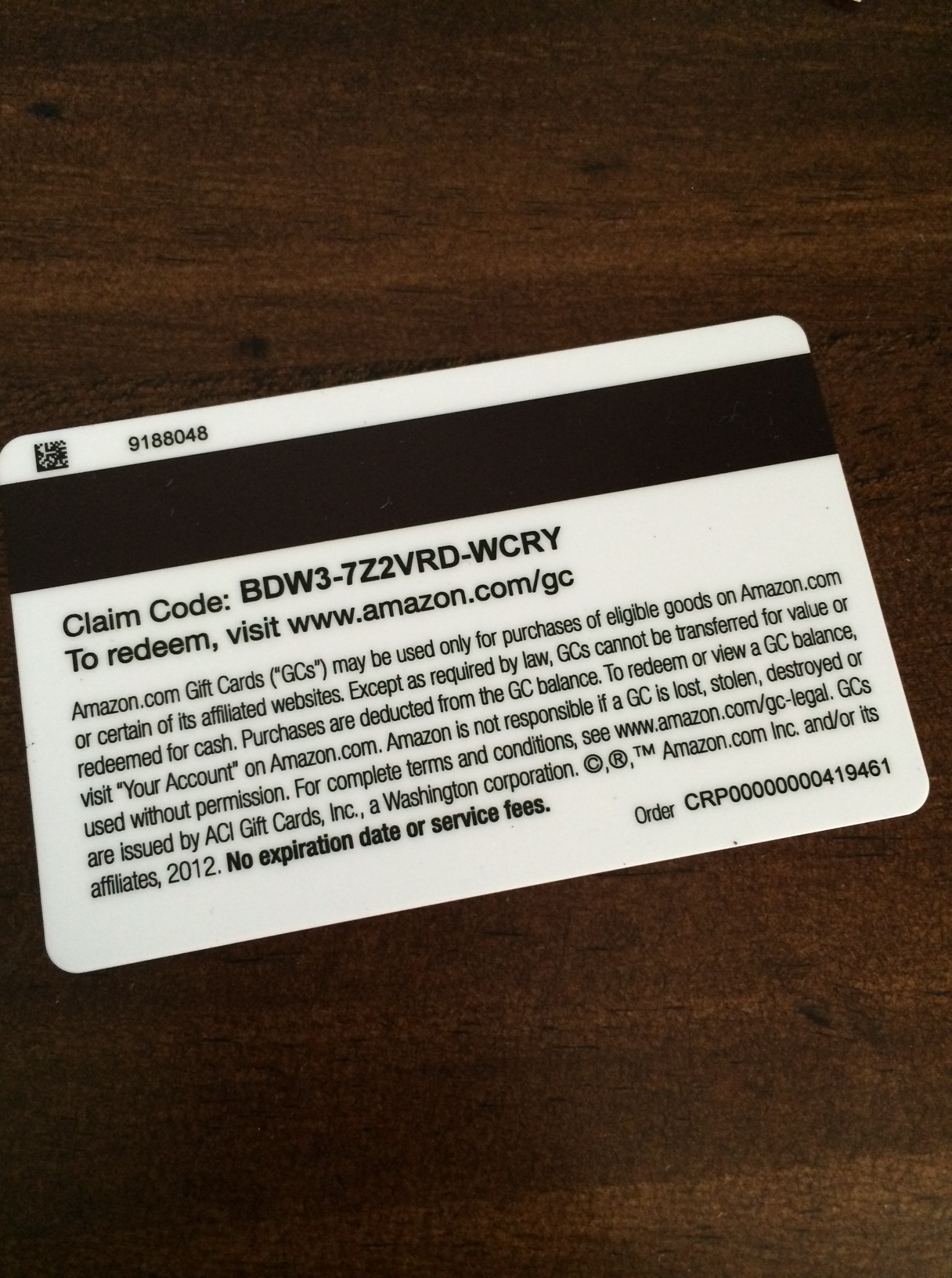
Supposedly the Amazon app can scan real world objects. But Amazon requires you to manually enter the claim code. You should be able to scan a bar code or QR code to automatically apply the code to your account after logging in. OCR technology is also good enough that you should be able to scan the text as printed.

Amazon has a wide range of gift card products. Some of the responses focused on emailing gift cards and doing things electronically. Amazon already does that.

But Amazon also offers gift cards at retail and through incentive programs. This particular gift card was received through a credit card rewards program. I’m not exactly sure what the magnetic stripe is for, because I can’t swipe it on my computer. My best guess is that it’s for activation.

This particular card doesn’t have the scratch off; cards sold at retail do. (There used to be gift card fraud where crooks would copy down activation codes and wait for them to be activated.)

  • Print the card on card stock so it can be recycled or biodegrade. Whole Foods does this with their gift cards. I’ve seen other gift cards made of a plasticky corn based product.
  • Use all alphabetic characters. The intermingling of numbers and letters makes entering the code on mobile devices especially hard because you have to toggle between keyboards.
  • Make the print of the redemption code larger so that older folks or folks with vision issues can more easily read it.

iTunes already does this, making it easy to redeem Starbucks app and song of the week codes.

The most fundamental flaw in FICO credit scoring

Imagine two borrowers.

Borrower 1

  • Has a $20,000 credit limit on 1 card.
  • Is using $5,000 of that credit limit.
  • Makes $25,000 a year.
  • Has no assets to speak of; essentially a net worth of $0.
  • Has a mortgage and a car loan.

Borrower 2

  • Has a $7,500 credit limit on 1 card.
  • Is using $5,000 of that credit limit.
  • Makes $250,000 a year.
  • Has $300,000 in liquid assets.
  • Paid cash for car; mortgage is paid off.

Who is the better credit risk? Most humans would say borrower 2.

But the FICO scoring model would say borrower 1.

The fundamental flaw in FICO is that it doesn’t take into account the income or assets of the borrower. It focuses on things like credit utilization, recent inquiries, etc. Someone who makes $500,000 looking for a $25,000 line of credit is more likely to be able to repay that loan than someone who makes $30,000.

The FICO model has many, many flaws. Another significant one is that it often creates scenarios where doing the economically optimal thing reduces your FICO score. We’ll cover that in a later quiz.

A small change lets PenFed make a lot more money on credit cards

photo (5)

PenFed sent me a new Visa without asking. Why?

In one case, it is “Platinum”. In another it’s “Signature.”

The interchange rates for Signature cards are substantially higher than for Platinum cards. The issuing bank can make a lot more on transactions simply by “upgrading” the customer to Signature. This is virtually no cost, aside from re-issuing the cards. There are a bunch of services that come with Signature status (like concierge), but these are low-use services of marginal value.