redesignAnswer: The car was previously owned by a rental car agency and sold due to an accident resulting in frame damage

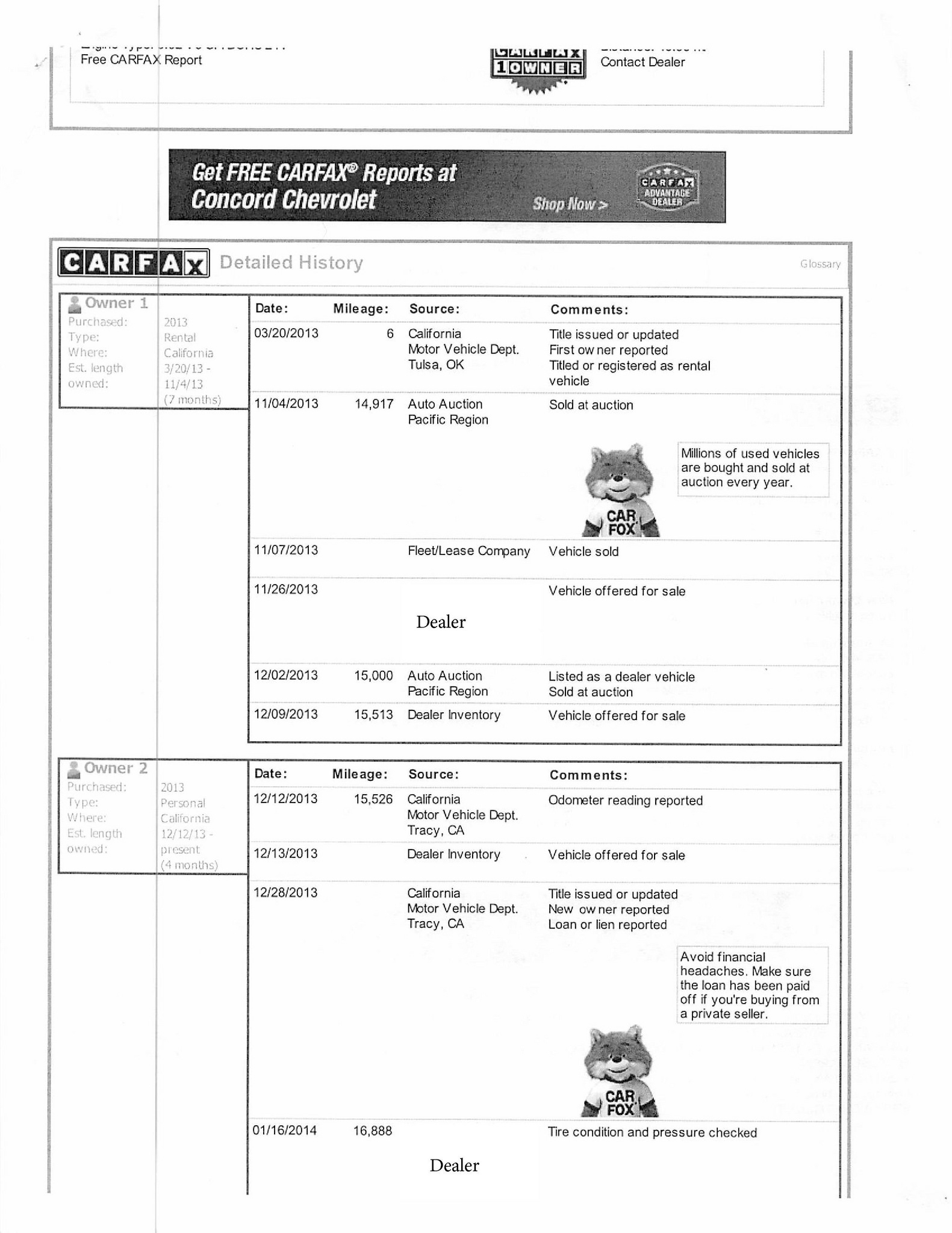
The first factor is clear: the CarFax report discloses the car as a former rental vehicle under the “Owner 1” information.  Rental vehicles are often driven hard, and are rarely worth the same as non-rental vehicles in a fair market.  A closer look, however, reveals the second–more important– factor:  the rental company only owned the car from 03/30/2013 to 11/04/2013, or a little over 7 months.  The average time-in-service for a rental vehicle is 13 months.  This car is well short of that average.  One of the primary reasons a rental company sells a car this soon after putting it in service is that the car presents a liability.

Title history reports such as CarFax typically turn up major repair work processed by insurance companies, but most rental agencies are self-insured and the repairs done by captive body shops. The wreck will never show on the title, despite such information being one of the primary purpose and marketing points of ordering the title history.  Only an inspection by a body shop revealed this car’s damage to its frame and sub-frame.  The damage, as it turns out, is a safety issue and the car is not worth anything near fair market value of a non-wreck.  The CarFax gives a false impression of quality here, and in many unreported wrecks.

Beyond my friend getting ripped off (though I am working on fixing that for him), the quiz raises a broader issue.  Title history companies have little incentive to find prior-wreck information when not branded on the title, nor do they adequately disclose such blind spots.  Certainly, CarFax has a “CarFax Guarantee,” but it only covers situations where CarFax misses a title actually branded as prior wreck or other defect.  When the defect is hidden from the title for some reasons, the title history provides a false comfort.  A better car history model would be consumer facing and use the information in the title history indexed against known defects to provide alerts that the buyer may wish to consult with a professional about the value of the car.  For example, a report could advise consumers that a rental agency sold the car before reaching the average in-service date and recommend the consumer consult a body shop.  The service could even extend its reach by partnering with local body shops and providing recommendations or a platform for advertising.

At redesignmobile, we see it as our mission to uncover holes in consumer service and work to fill them with solutions beneficial to consumers and the companies that serve them.  While we are not currently engaged to redesign the title history market, we also see it as our mission to bring such issues to light in the hopes that we can kickstart a discussion as to how we can all rethink, rebuild and redesign our world.

If you’d like to shine a light on other flaws in title history reports, or any consumer related matters, feel free to drop me a line at chuck at redesignmobile.com. I’m more than happy to listen.

This leads to today’s question: Why doesn’t CarFax provide a simple score for each vehicle? Or put a red flag next to the big red flags?

NOTE:  The CarFax report also shows an odd title history under “Owner 1.”  It appears that the car was sold at auction to a dealer and returned before landing with a second dealer who then sold it to Owner 2.  It is impossible to tell from this report alone whether anything truly unusual happened, or whether the report is capturing an oddity in the transfer from the auction house to the dealer.  In any event, in the context of the other information, this should be noted as another red flag and put the buyer on alert.


CarFax Quiz


Rocky got this one right.

redesignQuiz: Why was this used car purchase a bad buy?

The image below is a CarFax report showing the title history of a used car recently purchased by an acquaintance. CarFax, in case you do not know, is the current industry leader providing auto title histories to consumers and dealers alike. CarFax markets itself as providing information that may impact the purchase decision of a car through a detailed VIN history.

For the purpose of this quiz, assume this car was sold at fair market value for a typical car of this make and model year. When I saw this CarFax report, I told my friend he should make all efforts to undo the deal immediately. There are at least two factors in this report that should have warned him away from purchasing this car for that price. List the factors and explain why this was a bad deal.

NOTE: I redacted the dealer’s name.


CarFax
CarFax


Submit your answer here.

redesignAnswer: The tab is broken because I waited 15 minutes for “service” and gave up

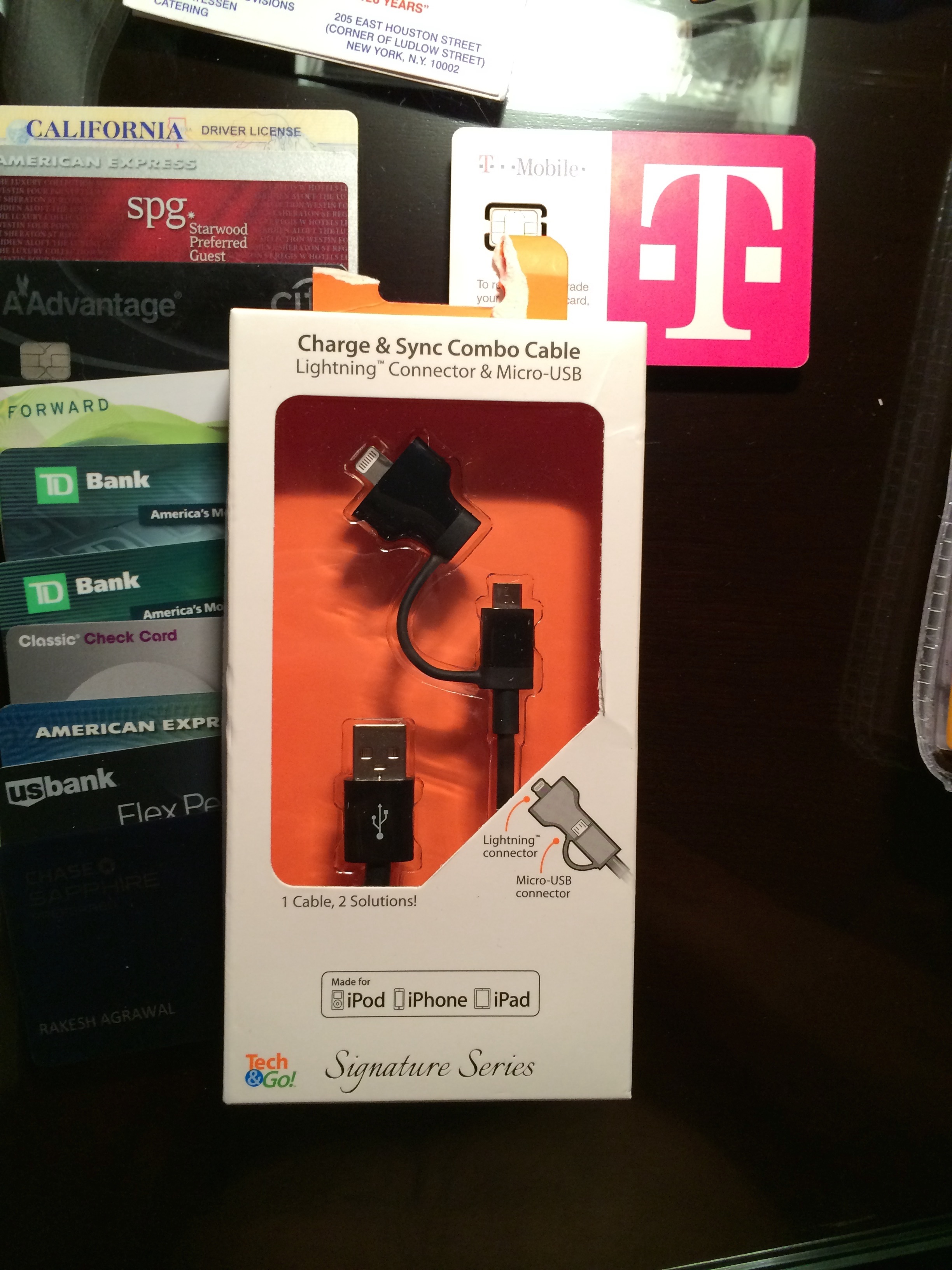
Cable with tag torn


The tab on this cable is broken because it was locked to the peg. There was a customer service button to press; I pressed it. A store clerk walked by but didn’t have the key; I asked her to find someone who did. 15 minutes later, I gave up and ripped off the tab. (I did pay for the merchandise.)

But most consumers wouldn’t wait more than 2 minutes. So this “security” measure deters sales.

It also doesn’t deter theft! If someone wants to steal it, they can just do what I did. Another alternative is to pull the peg entirely out of the peg board and remove it from the back.

So you’ve made it hard for legitimate customers to buy the product while only adding a speed bump for thieves.

This is also a case where the maxim about letting your data make your decisions falls flat. Such analysis ignores what you can’t measure. In this case, it is lost sales. You can measure theft — number of units put on display minus number sold. Measuring opportunity cost — the units you didn’t sell because people didn’t want to wait — is harder. (Though it can be done.)

Opportunity cost in this case is especially high because this a high margin product. Every lost sale hurts more than every theft.

Of course, Walgreen’s could improve service levels so that someone would actually come and unlock the product. But that requires more staffing.

Another answer, which Sam came up with, is that the item was on a peg with assorted merchandise. Rather than slide everything out to get to the one she wanted in back and then slide everything back on, she’d just rip the tab for the one she wanted.

redesignAnswer: Why is the back of the subway stairs protected with an enclosure?


photo-3

The enclosure (or similar structure) behind this subway staircase is required by the Americans with Disabilities Act of 1990 for all public buildings and some private residences; it protects commuters with visual impairments from injuring themselves on the underside of a protruding object. In the absence of the enclosure, a blind commuter would bump into the staircase head-first before her cane made contact with an obstacle. Incidentally, it also protects those of us who walk and text simultaneously. (This does not constitute an admission of guilt on the part of the author!) Some subway stations have a storage closet built under the stairs; this station keeps it simple with a bare-minimum railing.

Bonus point if you guessed the station–It is Jay St.-Metrotech on the A/C/F lines.

— Sara

Rocky’s comments:

I didn’t get this answer correct. My answer — and the answer of a lot of people — was that it is there to prevent perverts from looking up skirts or kilts.

Another guess I had was that it would keep snow and ice from shoes from going through the stair case and creating slippery puddles below.

Subways often have little yellow bumps at the edge of the platform (seen toward the right above) to help the visually impaired. This is called tactile paving.

One of the goals of redesign mobile is to push for the design of products for people of all abilities. Victor got this answer immediately. As the father of an autistic child, he’s especially passionate about designing products for people of all abilities.


redesignQuiz: Why is the back of the subway stairs protected with an enclosure?

The back side of the staircase

I take the subway every day, both out of necessity and because I love public transportation. The backside of the staircase in this subway station has a metal enclosure around it–what purpose does it serve? (Hint–the answer is not specific to this location.

Answer here.

The most fundamental flaw in FICO credit scoring

Imagine two borrowers.

Borrower 1

  • Has a $20,000 credit limit on 1 card.
  • Is using $5,000 of that credit limit.
  • Makes $25,000 a year.
  • Has no assets to speak of; essentially a net worth of $0.
  • Has a mortgage and a car loan.

Borrower 2

  • Has a $7,500 credit limit on 1 card.
  • Is using $5,000 of that credit limit.
  • Makes $250,000 a year.
  • Has $300,000 in liquid assets.
  • Paid cash for car; mortgage is paid off.

Who is the better credit risk? Most humans would say borrower 2.

But the FICO scoring model would say borrower 1.

The fundamental flaw in FICO is that it doesn’t take into account the income or assets of the borrower. It focuses on things like credit utilization, recent inquiries, etc. Someone who makes $500,000 looking for a $25,000 line of credit is more likely to be able to repay that loan than someone who makes $30,000.

The FICO model has many, many flaws. Another significant one is that it often creates scenarios where doing the economically optimal thing reduces your FICO score. We’ll cover that in a later quiz.

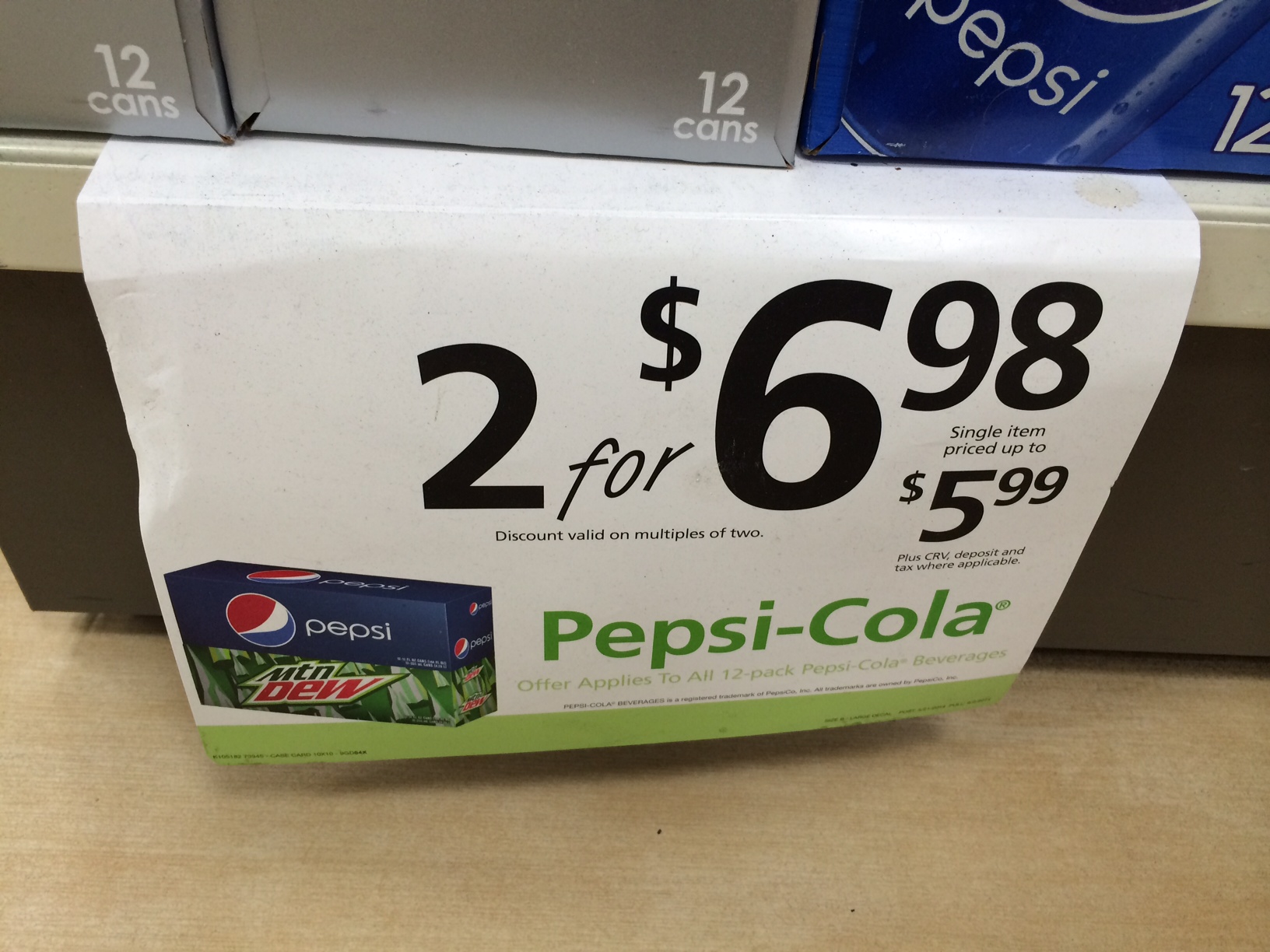
redesignAnswer: If two 12-packs of Diet Pepsi cost $6.98, how much does one cost?

Like many marketing and pricing questions, this one doesn’t have a “right” answer. It depends on the philosophy of the company and what you’re trying to achieve.

Here, you’re balancing the consumer desire for “fairness” with the desire to maximize either revenue or margin.

The “fair” answer is $3.49, which is exactly half of the cost for two. The revenue maximization answer is $6.97, because it basically forces everyone to buy two.

There are other considerations, too:

  • Will you look like you’re forcing consumers into bad choices? Especially with health concerns, you might look dickish to regulators. A great example of this is when McDonald’s offered 1 pie for 99 cents and two pies for $1. This played into the notion that McDonald’s wants you to eat poorly. Bad for PR.
  • CPGs like PepsiCo offer a wide range of marketing incentives depending on volume.

In general, I find that stores like Target tend toward the “fair” end of the spectrum in unit pricing. Drug stores such as, Walgreen’s and CVS, and C-stores, like 7-11, tend toward the revenue maximization.

The picture in the question was taken at a 7-11. The price for two was $6.98. The price for one was “up to $5.99” on the sign. I didn’t try to buy a single unit just to see what the actual price was.

photo (7)

A small change lets PenFed make a lot more money on credit cards

photo (5)

PenFed sent me a new Visa without asking. Why?

In one case, it is “Platinum”. In another it’s “Signature.”

The interchange rates for Signature cards are substantially higher than for Platinum cards. The issuing bank can make a lot more on transactions simply by “upgrading” the customer to Signature. This is virtually no cost, aside from re-issuing the cards. There are a bunch of services that come with Signature status (like concierge), but these are low-use services of marginal value.

redesignAnswer: The easiest, most productive way to improve @Uber screen is…

… to add the color of the vehicle.

Having the picture of the driver, type of vehicle or license plate number isn’t useful when you’re trying to spot the car from a block and a half way.

You can see color from a block and a half or two blocks. (Depending on the size of the blocks, of course.) If you’re well versed in vehicle models, you might be able to see it from half a block or a block. (Unless it’s a Prius, of which there are many.) You certainly can’t read the license plate until the driver is a few feet away.

The driver’s picture is useless until the driver is right in front of you. Maybe when the driver is within 10-20 feet, the map and the vehicle info zooms into a picture of the driver.

Putting the color of the vehicle would be a huge improvement.

It would make it easer:

  • For passengers to find their driver.
  • Get passengers to hold their phone out or otherwise signal the driver.

It would also prevent incidents like what happened to me on Sunday — the driver sped past me at at least 30 mph. And then backed up several hundred feet in one-way traffic. Clearly unacceptable in my book.