
Why I expect Allo to struggle

Google this week launched, Allo, the latest in its efforts at social. We’ve seen a long Wave of Google social products that have failed. Buzz, Wave, OpenSocial, Google+ on the pure social side. When you look at the subset of messaging apps, this includes gTalk, Google Voice, Google Hangouts among others.

Allo is Google’s latest attempt to compete with Facebook Messenger, iMessage, WhatsApp and Skype.

There is no clear reason to adopt this. Why is a user going to adopt Allo? Is it for:

  • Tons of emojis. (Piece of cake to emulate.)
  • To play command line games? Zork 2016 (Piece of cake to emulate.)
  • Google Assistant.
  • whisper SHOUT. (Piece of cake to emulate. iOS 10 includes this.)

Better to pick one thing and knock that out of the ballpark. You aren’t going to win FB Messenger users over with emoji. Given Google and Facebook’s relative strengths and weaknesses, I’d bet it all on Google Assistant. Another plus: It adds virality to Google’s other products.

The initial implementation of the assistant is an OK start, but there’s a long, long way to go. Google Assistant is like most bots, it overpromises and underdelivers.
fullsizerender-5

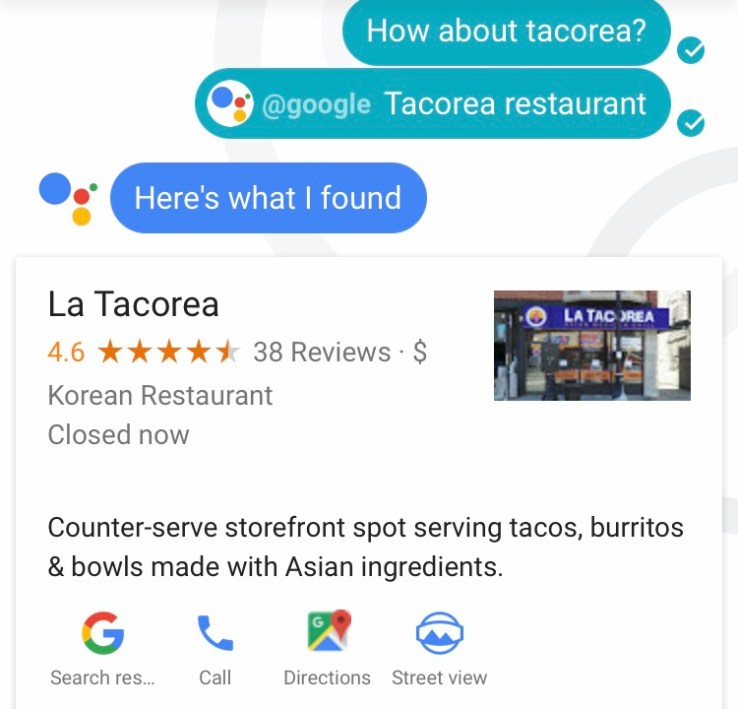
One of the challenges in natural language processing is understanding entities. When I asked a friend “Do you want to meet up at blue line pizza tonight?”, I got a search suggestion for “Pizza places nearby”. It didn’t recognize that “blue line pizza” is an actual place. When I said “How about tacorea?” It gave me the correct suggestion of “Tacorea restaurant”.

Having worked in local, search and messaging, I know that entity extraction is an incredibly hard technical problem. So I’m going to be more forgiving than most people. A lot of users will just feel that the experience is broken.

Google is also behind in another way: Unlike Facebook and iMessage (and even Google Hangouts), there is no desktop experience. I wanted to send a link to this post to a friend over Allo (after I wrote it on my Mac), but had to send it via Hangouts instead.

The biggest challenge for Allo will be distribution. I already have plenty of ways to message someone: Facebook Messenger, WhatsApp, Skype, SMS, Line, Twitter DM, iMessage.

iMessage succeeded because it Apple just took over SMS transport for iPhone to iPhone messaging. (Apple was able to do this because it has always been able to dictate the rules to carriers.)

WhatsApp built its base outside the U.S. The primary reason people adopted it initially was to avoid paying the exorbitant cross-border SMS and MMS fees. There was an easy, compelling reason to switch.

Facebook Messenger used its insane time-on-site and hundreds of millions of users to build its user base. They had a massive (and personal) friend graph to work with.

So far, I haven’t seen anything from Google about how it’s going to attract users.

PR tips for startups

6277209256_934f20da10_bGetting attention for a startup can be hard. There are thousands of startups out there of various size. How do you break out from the noise? Here are some tips on the best ways to get coverage of your startup. They draw from my experience both as a journalist and someone who has been interviewed by many media outlets.

One tip that applies to all startups: never spam reporters. It may be tempting to compile a list of all the various tips@ media@ etc. from every tech site and blanket spam them. Never do that.

A reporter’s job is to tell a story, not a story about you.

Companies 1-10 people

You don’t need to hire a PR firm. (You probably can’t afford one anyway.) The odds that a $5,000 a month retainer for your startup will get you meaningful coverage is slim to none.

Here’s what I would do instead:

  • Set up a Google news alert for a competitor and for industry news related to your company’s business.
  • Read about your areas of focus intently.
  • From those two, you should be able to compile a list of writers who cover your space. You don’t need to (and shouldn’t) reach out to every writer at TechCrunch; find the one or two who specifically focus on your business area.
  • Follow those writers on Twitter.
  • Writers will often ask for help on various topics related to their beat. Help them out, help them to understand their space. Do this in a non-promotional way. If you have specific data or consumer experiences, definitely share them.

Me experience is that journalists are relatively forgiving to startup CEOs.

Greater than 10 people

At this point, it begins to make sense to hire an agency.

Here’s how I’d go about it:

  • If they pitch you with “coverage” they’ve gotten in “publications” like PR Newswire or Businesswire, run away. In the era of blogs, you don’t need to pay for this worthless distribution.
  • Talk to the actual person who would be doing media outreach, not just the account rep. Assess whether they are personable. You want someone who is outgoing. Abrasive personalities are not good for PR.
  • Look at what kind of coverage they’ve been able to get for similar-sized companies. Have realistic expectations. (See below.)
  • If you’re in the local space, listen to the kinds of publications they pitch you on and what coverage they can get. In local, you want local and regional coverage. That gets you customers; tech blogs and national press give you credibility with partners and investors.
  • I’d bias to smaller agencies or independent PR people, where your retainer actually means something to them. It makes it more likely that you will get their time.

Outcomes

Startups (and companies in general) tend to have unrealistic expectations of outcomes, especially when talking to major publications like Businessweek, the Wall Street Journal and New York Times. If your CEO spends 30 minutes on the phone and you get a paragraph of coverage, that should be considered a success. This is especially true for recorded radio or TV interviews. I’ve had 20 minute conversations that were edited down to 3 second sound bites.

When the story appears, send a thank you email to the writer. If there were errors or misperceptions in the piece, offer clarifications for future pieces. If there were egregious misrepresentations, call them out in a nice way. Only people like Elon Musk can tear into a reporter.

DON’Ts

These apply whether or not you have an agency.

  • Do a blog post about your news and then share it with reporters. At that point, it’s not news. Unless you’re Facebook, Google or Apple, it’s unlikely that a reporter will write about it once it’s out there.
  • Send a link to a story a competing reporter has written. Again, not news. Also implies that the other writer was more important.
  • Send messages that are “EMBARGOED,” except to journalists who have agreed to accept an embargo. (Embargoed stories are ones that won’t be released until a certain time. For example, a product launch.)
  • Send messages that are “Off the record.” Off the record is something that has to be agreed to by the journalist. In general, I won’t say things that are off the record except to journalists I trust.

Have questions on startup PR? Find me on Twitter – @rakeshlobster.